By Mike Davis
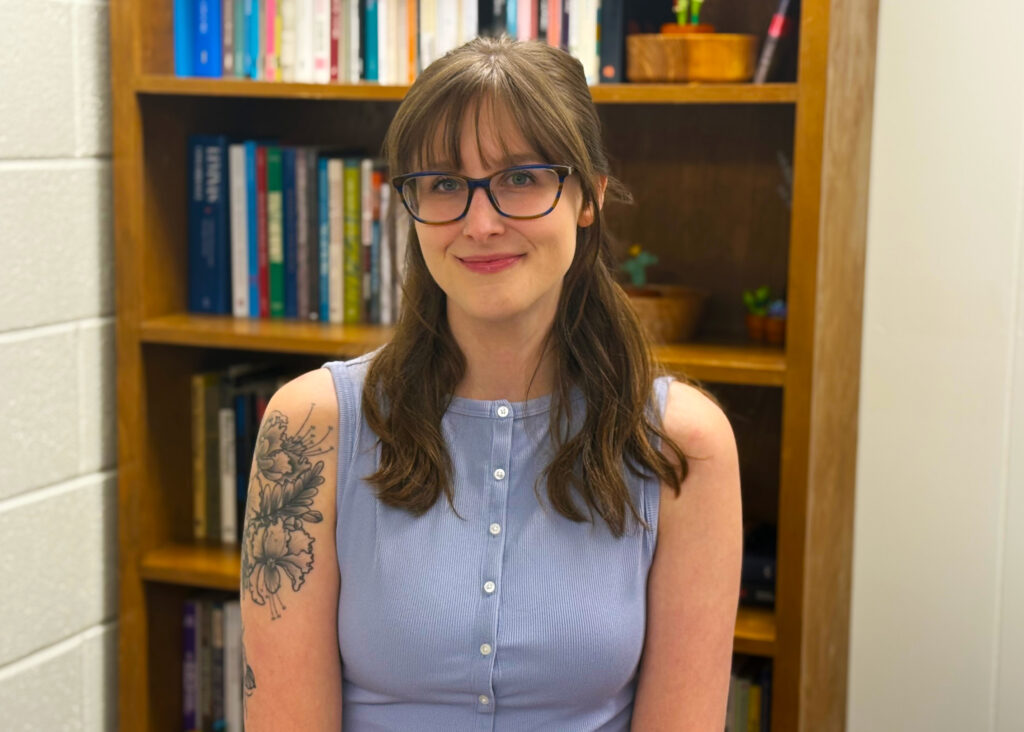
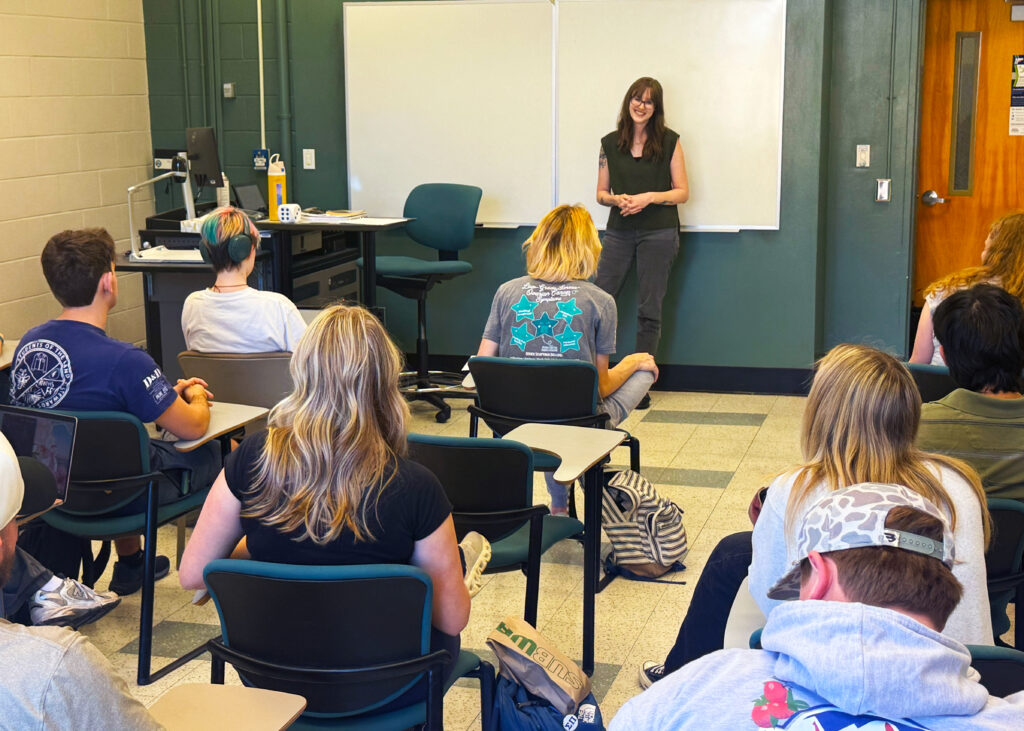
MURFREESBORO, Tenn. – When Dr. Kaity Newman walks into room 202 of the James Union Building, she can’t help but smile. The room feels familiar. Not just because she’s taught here this semester, but because it’s the same classroom where, more than a decade ago, she sat wide-eyed as an undergraduate student taking Introduction to Philosophy at Middle Tennessee State University.
“Standing at the front of that room now, where I once sat as a student, it’s surreal,” Newman said. “It feels really good being back on campus”
Newman grew up in Murfreesboro and, like many local students, initially planned to spread her wings and enroll somewhere else. “I toured other schools like UT and a few others, but nothing felt right,” she said. “Then I took a dual-enrollment class at MTSU my senior year of high school, and it immediately felt like home.”
Her early plan was to major in biology, following in her family’s STEM (science, technology, engineering, and math) footsteps. But one philosophy class changed everything. “I thought I’d hate it,” she laughed. “Everyone says, ‘Take philosophy if you want to go to law school,’ so I did, and I loved it. It opened a completely new way of thinking for me.”
That single class grew into a double major in Philosophy and International Relations within the College of Liberal Arts, setting her on a path that would ultimately lead her back to MTSU, not as a student this time, but as a professor.
After graduating from MTSU, Newman spent a year working locally before enrolling in graduate school at Penn State University, where she completed her Ph.D. in philosophy. She later joined the faculty at Georgia College, a small liberal arts institution, where she spent five years teaching and honing her craft in the classroom.
But when Newman learned that one of her former mentors at MTSU was retiring, she saw an opportunity to return home. “It just felt right,” she said. “I applied, got the job, and it feels like I’m exactly where I’m supposed to be.”
Now, back in Murfreesboro and teaching the very course that first sparked her curiosity, she says the experience is both nostalgic and deeply rewarding. “I always knew that wherever I ended up working after graduation, I wanted it to be somewhere that cared about undergraduate education and that allowed and encouraged faculty to have those connections and relationships with students because that meant so much to me as a student.”
For Dr. Mary Magada-Ward, chair of the Department of Philosophy and Religious Studies, Newman’s return is both professional and personal. She remembers Newman as a bright, diligent student with a quiet confidence that shone during class discussions.
“She was always such a thoughtful and mature student,” Magada-Ward said. “I still remember her presentations because she was always poised, insightful, and deeply reflective. It’s incredibly rewarding to see her now as a colleague. It’s like watching your kid grow up.”
Magada-Ward also notes that Newman’s presence carries special significance for the department and for MTSU. “Kaity is only the second woman philosopher in the university’s 114-year history,” she said. “I was the first. So seeing her here now, it’s personally very meaningful.”
For Newman, the liberal arts teach students how to think, question, and connect. “Philosophy helps you become an informed, engaged global citizen,” she explained. “It teaches you to analyze arguments, think critically, and communicate clearly. Those skills are valuable no matter what career you pursue.”
She also challenges the misconception that humanities degrees don’t lead to meaningful or successful careers. “I’ve had students go on to work in law, business, tech, and public service,” Newman said. “Philosophy teaches you how to learn and adapt and that’s what employers really want.”
Magada-Ward echoed that sentiment, adding that philosophy graduates are uniquely equipped for success. “On average, within ten years, philosophy majors earn nearly twice what business majors make,” she noted. “That’s because they learn to answer the ‘so what?’ question and to connect knowledge to human flourishing.”
Newman’s story serves as a powerful example for current and future MTSU students. Proof that a liberal arts education can take you far, and sometimes even bring you back home.
Her goal now is to give students the same kind of mentorship and encouragement that once shaped her own path. “I want them to see that philosophy, and the liberal arts more broadly, are living, dynamic fields that matter in the real world,” she said. “And I want them to know that it’s okay to follow curiosity wherever it leads.”
Stories like Newman’s are a reminder that the College of Liberal Arts is more than a collection of departments, but rather a community that shapes thinkers, leaders, and teachers who go on to make a difference.
As Magada-Ward put it, “When you invest in liberal arts, you’re investing in the capacity for empathy, critical thinking, and understanding. You’re helping create citizens who can bridge divides and imagine better futures.”
For Dr. Kaity Newman, that investment paid off, and she’s now paying it forward, back where it all started.